Preface-2
That picture illustrated two basic operations—adding vectors () and multiplying a vector by 2. Combining those operations produced a "linear combination" ():
Those numbers () and () can be negative. In that case () and () will reverse their directions: they go right to left. Also very important, () and () can involve fractions. Here is a picture with a lot more linear combinations. Eventually we want all vectors ().
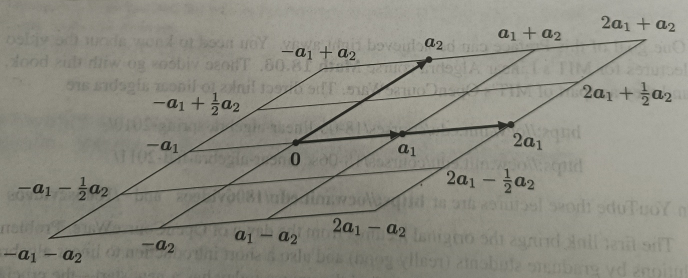
Here is the key! The combinations () fill a whole plane. It is an infinite plane in 3-dimensional space. By using more and more fractions and decimals (c) and (d), we fill in a complete plane. Every point on the plane is a combination of () and ().
Now comes a fundamental idea in linear algebra: a matrix. The matrix () holds () column vectors (). At this point our matrix has two columns () and (), and those are vectors in 3-dimensional space. So the matrix has three rows and two columns.
The combinations of those two columns produced a plane in three-dimensional space. There is a natural name for that plane. It is the column space of the matrix. For any (), the column space of () contains all combinations of the columns.
Here are the four ideas introduced so far. You will see them all in Chapter 1.
- Column vectors () and () in three dimensions
- Linear combinations () of those vectors
- The matrix () contains the columns () and ()
- Column space of the matrix = all linear combinations of the columns = plane